

New exhibition, events illuminate the art and science of fireflies
Photograph by Nolan Bonnie currently on view for the exhibition.
A new exhibition at the Earth Sciences & Map Library has set its walls aglow with the world of fireflies. Alongside the exhibition, two November events invite attendees to experience how firefly and bioluminescence research inspires across disciplines.
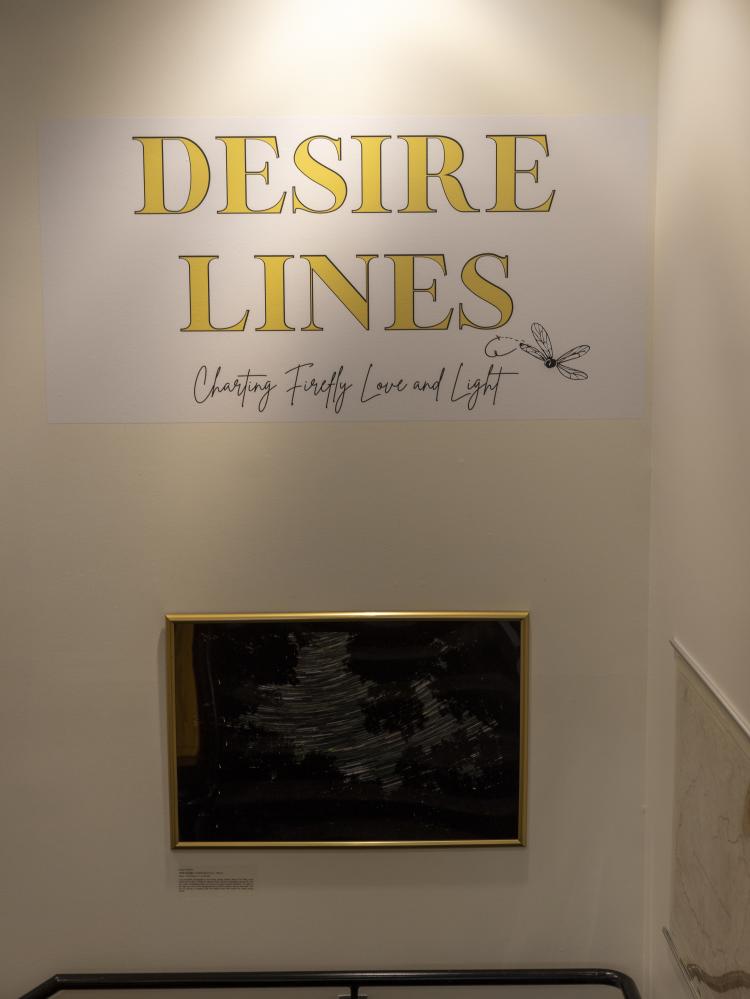
The exhibition, called Desire Lines: Charting Firefly Love and Light, blends art, science and geography. Its works present data and creative interpretations to deepen the viewers' understanding of fireflies’ nocturnal ecosystems and the connection between living light, creativity and nature.
A “desire line” is an informal path shaped by people or animals choosing more convenient routes. Fireflies trace their own bioluminescent paths or “desire lines” as they communicate with each other.
Two unique event experiences
The November events offer attendees the chance to dive deeper into the exhibition through poetry and a talk on deep sea bioluminescence.
Love Poems for Fireflies Poetry Workshop
Nov. 5, 2 p.m. – 4 p.m.
Earth Sciences & Map Library classroom, lower level
Fireflies attract mates with light, flickering in the night. Their illumination is communicative. Flashing is their language of courtship. Humans also use language, and some of our most exalted expression is poetry. Might the flickering of fireflies become poetic? What is the incandescent equivalent of a Shakespearean sonnet?
Join a two-hour poetry workshop led by conceptual artist and BioFrontiers visiting scholar Jonathon Keats, with Orit Peleg, associate professor of Computer Science at BioFrontiers. They will lead participants through the process of composing love poems for fireflies, presented on hand-made broadsides.
The Language of Light: Bioluminescence in the Deep Sea
Nov. 14, 4 p.m. – 5:30 p.m.
Benson Earth Sciences Auditorium, RM 180
In this talk, guest speaker Sönke Johnsen, Owens Distinguished Professor at Duke University, will explore how deep sea animals use light to communicate, startle, lure, trick, defend and even hide, as demonstrated by Johnsen's at-sea research experiences and photography.
Following the talk, join a reception at the Earth Sciences & Map Library from 5:30 p.m. to 6:30 p.m. Refreshments will be served.
This event is free and open to the public and registration is optional.
About the Desire Lines exhibition
The exhibition brings together art, science and cartography to explore the luminous world of fireflies and how living light intersects with geography and human imagination. It features poetry by CU Boulder students created for fireflies, long-exposure calligraphic photographs of synchronized firefly flashes and maps that situate firefly habitats in Colorado, as well as sites where firefly research is actively underway in the Smoky Mountains in South Carolina and Tennessee.
Behind the exhibition is a team of collaborators who each brought a different lens to the theme of “living light.” Orit Peleg, associate professor of Computer Science at BioFrontiers, served as scientific lead; conceptual artist and writer Jonathon Keats contributed as artistic lead; Assistant Director of NEST Studio for the Arts Joanne Marras Tate curated the installation; and Map Curator Naomi Heiser guided the selection and presentation of historical and thematic maps.
Together, they transformed firefly communication collected by the Peleg Lab and photography by Nolan Bonnie, a fourth year PhD student working in the lab, into an experience that invites visitors to not only connect with fireflies, but build an understanding of fragile nocturnal ecologies and the collective behaviors that animate them.
“When I see firefly flashes, I see biological Morse code: compact, time-coded signals in dim light," explained Peleg. “As a physicist and computer scientist, I am fascinated by how animals communicate reliably over narrow communication channels in noisy environments, and fireflies do this beautifully. There is, of course, potential for bio-inspired technology here, but my first motive is curiosity and respect for the animals.”
Peleg said that the exhibition translates her work in the lab—measuring how individual flashes connect into spatiotemporal patterns, and modelling how information moves through a swarm—into three elements. “The student poems reflect on pattern and meaning, the long-exposure “calligraphy” images make the codes visible, and the historical maps anchor the signals to place. I hope people leave with wonder for local nocturnal ecosystems, curiosity to notice and protect dark skies, and a sense that art and science together can decode living systems.”
Bonnie’s calligraphic photographs come from his work in the field studying how groups of fireflies coordinate communication and synchronize in large swarms. “Every year we travel to firefly hotspots in South Carolina and Tennessee to collect data on several firefly species,” explained Bonnie. “The data we collect is a mixture of natural swarm recordings, and controlled experiments.”
Bonnie said being surrounded by fireflies during fieldwork is awe-inspiring. “I found myself wanting to capture some of this beauty, and luckily our lab has access to some great low-light cameras. Every year, I take photographs of the fireflies while my experiments are running. It's been fun for me to refine this skill over the course of my PhD. The National Park Service and private land owners graciously give us access to their land to film these species, which is an incredible privilege. By taking these photos, I hope to allow everyone a glimpse into what it feels like to be there with the fireflies. Moreover, I have found that photography has been a great tool to help me communicate my science with a broader audience.”
For Keats, whose visual poem “For the Love of P. Pyralis” is on display and is leading the poetry workshop, the project ties into his practice as an artist and philosopher.
“For the past year, I have been a visiting scholar at CU Boulder and in Orit’s lab. We've been exploring a number of questions about intelligence, cognition and communication in various species, including honeybees and fireflies,” said Keats. “Orit and I discussed possible ways to engage her classes and others that would get into fundamental questions about what separates us from other life forms, such as fireflies, but more importantly, what we potentially have in common.”
Keats proposed that firefly flashes are a form of poetry—both used as a tool for courtship— creating a connection between our languages. By enlisting poetic techniques, Keats wrote poems using firefly flash patterns, with three now on display in the library.
He is now opening up the process for creating poetry for fireflies as a workshop at CU Boulder. “It’s a way to become more attentive to what possibilities there are in non-human communication and to investigate our own assumptions about our language—and about what we assume to be special about us,” explained Keats. “If the language of fireflies is capable of being expressive in a way that we consider to be the highest art form, the Shakespearean sonnet for example, there's a leveling that can take place. The works presented in the exhibition and the poetry workshop open up this idea to the public.”

A hub for collaborations
The Earth Sciences & Map Library has become a hub for these types of interdisciplinary collaborations. Marras Tate brought the idea for this exhibition to Heiser on behalf of NEST.
"NEST was the ideal group to make this exhibition happen because of our work across arts and sciences on campus and beyond. In my own research, I focus on meaning making happening in humanature encounters. Being a part of this exhibition felt particularly special to me as I learned about the different experiences people have with fireflies and their cultural significance.” explained Marras Tate. “This was truly a group effort from all collaborators, and I played the pivotal role of curating the exhibition, thinking conceptually and creatively to bring it together as a whole, and also in administrative aspects. In order to make it cohesive, we worked closely with Dr. Peleg to bring firefly communication and the experience of seeing fireflies to the library as we mixed photographs, maps and poems. The maps are primarily focused on her research sites, with some locations in Boulder where you can see fireflies.”
Marras Tate noted that the Earth Sciences & Map Library was the ideal location to bring the exhibition to life. “Naomi's expertise and passion for cartography emerged at every map she pulled from the library. Working with her and the library staff made this exhibition possible.”
Heiser and Map Library Program Manager Ilene Raynes often teach classes brought into the library by instructors, walking students through exhibitions and educating them on the various maps in the collection.
“We’re delighted to host another science visualization exhibition, in an area new to our collection focus,” said Heiser. “It was exciting to find that we hold some important maps of the Great Smoky Mountains area, which offer visitors a window into characteristics of a supportive firefly environment. This semester, classes are interacting with the exhibition to consider questions about human-built parks versus “Nature” and how to read maps to understand environmental features.”
The exhibition is on view through the end of February 2026. Those interested in scheduling a class visit to view the exhibition can contact maplib@colorado.edu to schedule an appointment with Heiser and Raynes to discuss course goals.