

The history of CU Boulder’s red sunflower was nearly discarded. Now it's a successful Libraries program
Red sunflowers are now blooming on campus thanks to the University Libraries One Seed program, but their story almost disappeared. The striking flowers trace back to CU Boulder professor Theodore Dru Allison Cockerell and his wife Wilmatte Porter Cockerell, a high school biology teacher, whose pioneering work in entomology and biology almost got tossed away.

Professor T.D.A. Cockerell sits in his office in the Hale Science Building.
“Up until the 1960s, Cockerell's papers were kept in his former office in the Hale Science Building,” explained Rare and Distinctive Collections Instruction Coordinator Sean Babbs. “One day, these papers were being disposed of to make room for office space. CU professor and botanist William Weber stopped it and saved them, including the original specimen of the red sunflower that had grown wild back in 1910.”1
Thanks to Weber, the T.D.A. Cockerell Collection is now in the archives of the University Libraries Rare and Distinctive Collections. Its 120 boxes of materials contain Cockerell’s research notes on species, letters from colleagues, films, photographs, and the original sunflower. Materials from the collection can be viewed in-person by scheduling an appointment. A small portion of the collection is available online via the CU Digital Library.
“We were sorting through the Cockerell collection to find and digitize material related to excavation of the Florissant Fossil Beds when we came across the red sunflower specimen. It's in remarkable condition for its age,” said Babbs. “The petals still contain their red pigment, only slightly dulled from time.”
The history of how the red sunflower was cultivated—and saved—is as serendipitous as its rediscovery in the archives. In 1910, Wilmatte noticed a red sunflower growing in the wild across the street from her home. Together, the Cockerells cultivated the seeds carrying the red mutation and eventually sold them to seed companies. Genetic material from that first flower is now available all over the world.
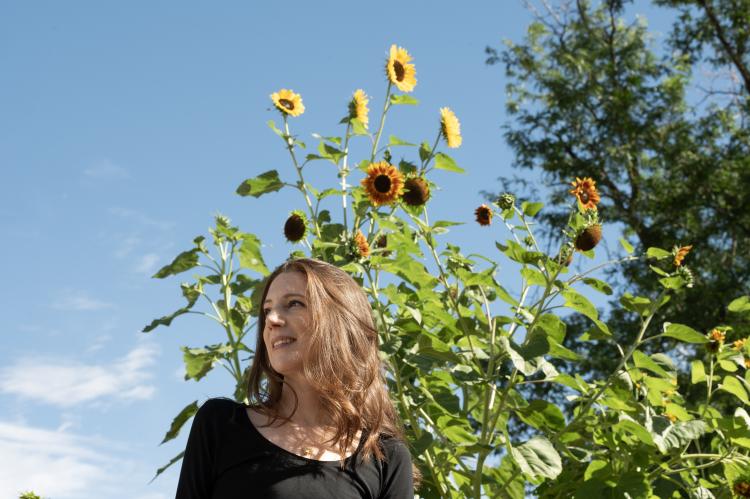
STEM Engagement Librarian Abbey Lewis started One Seed in 2021.
Sowing interest in campus history
“We started One Seed as a way to share the T.D.A. Cockerell Collection, a vibrant part of our archives with unique materials that relate directly to the university’s history,” explained STEM Engagement Librarian Abbey Lewis who started the program. “We were inspired by the Libraries Buffs One Read program and seed libraries, which give away seeds to their local community.”
Since One Seed began in 2021, Lewis and her team have distributed over 7,200 seed packets to the community for them to grow in their own gardens—an approximate 108,000 red sunflowers.
Much of the success of One Seed is the result of their diligent outreach efforts hosting events and giving seeds to various university groups such as the Herbarium, Environmental Center, the student-led CU Farm and Garden Club and Outdoor Services in Facilities Management.
“We’ve shared seeds the past four Earth Days. Folks will return to the table each year and talk about the flowers they’ve grown and what they are planning. I always ask how high their flowers have grown or how red they are because there can be a lot of variation,” said Lewis.

The sunflowers stalks act as a pole-bean trellis, an idea stemming from the Native American companion planting technique called Three Sisters.
Trying out a new planting technique
This year, the Farm and Garden Club planted seeds at their Table Mesa Community Garden.
“Planting the sunflowers is a way to engage with the broader CU Boulder community, promote biodiversity on and off campus, and teach members of the club how to address garden challenges in an innovative way,” said Grace Hutchens, student lead for the club and a senior double majoring in environmental studies and biology. “Sunflowers also promote pollinator abundance in the garden and feed a variety of bird species around Colorado.”
The club took a unique approach to planting the sunflowers.
“The idea came from the Three Sisters method, which is a classic Native American companion planting technique that maximizes harvests by utilizing each plant's ecological niche,” explained Hutchens. “We plan the layout of the garden based on soil health, crop rotation schedules and differing levels of sunlight. We planned on planting beans in areas where we had crops that are heavy feeders. Beans place nutrients back into the soil and are a great producer themselves. We wanted the sunflowers to look nice but also provide an ecosystem function, so we decided on using the stalk of the sunflower as a pole-bean trellis. This removed our need to buy new trellising material and created an example of how you can get creative with companion planting."

A bee lands on a red sunflower bloom on the CU Boulder campus.
Growing a redder flower
This is CU Boulder Horticulturist Jason Wiley’s second year growing the flowers on campus. Last year, the majority of sunflowers turned out yellow.
Genetics, Wiley said, are the biggest factor for how red—or yellow—they will ultimately be. “Extremely hot weather can also sometimes bleach out the color and there may be a correlation between red veining in the leaves and red flower color.
Because of the genetic influence, for this year’s batch, Wiley sought to cultivate more red in the petals by harvesting seeds from last year’s reddest flowers and hand-pollinating them.
“Aaron Shapiro, another horticulturist at CU, as well as myself, hand-pollinated only the red flowers using a watercolor paintbrush,” explained Wiley. “By crossing reds with reds and collecting seed only from those plants, we increased the likelihood of producing red offspring. We’ll continue this technique again this year to see if we can push the color even further. In fact, one plant in the circle planter this year is nearly black and it will be fascinating to see if we can eventually achieve that consistently in future generations.”
Their efforts have paid off. Visitors to the garden beds on campus will be able to see much more red throughout the pedals.
For home gardeners looking to grow a redder flower, Wiley said they should follow the same approach as they took: “Hand-pollinate only the red flowers with a watercolor paintbrush and save seeds only from those plants. To increase your chances further, remove or clip nearby yellow-flowered sunflowers. You can sow seeds more densely than needed, then thin by pulling out the yellow ones as they bloom.”

The Cockerells with red sunflowers, Boulder, CO, 1935.
Inspiring other libraries
Recently, Lewis and Babbs published an article in the spring 2025 issue of the Marketing Libraries Journal detailing One Seed’s success and how other libraries can take advantage of unique university histories to drive interest in library archival collections.
“I wanted to encourage other libraries to create similar programs to engage their community,” explained Lewis. “I wanted to say to them, ‘Hey, you might have a story like this in your collections that you can use to connect with people, whether it's a flower with ties to your institution or something else. Look for this in your archives.’ I hope there is a library out there that can find that. Archives and institutional history are a great thing to promote. It resonates with people.”
As for the future of the One Seed program: Lewis still plans on giving away the red sunflower seeds every year on Earth Day, but she is also interested in what other histories are waiting to be rediscovered in the Libraries collections and how those can be connected with the community just like One Seed.
1William Weber wrote about saving the collection in the editor’s note of The Valley of the Second Sons: Letters of Theodore Dru Alison Cockerell, a Young English Naturalist, Writing to His Sweetheart and Her Brother about His Life in West Cliff, Wet Mountain Valley, Colorado 1887-1890.